

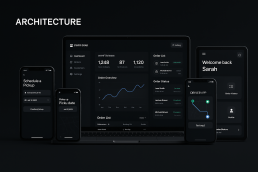
Building a Full-Service Laundry Platform with Real-Time Tracking and Multi-Role Automation
Building a Full-Service Laundry Platform with Real-Time Tracking and Multi-Role Automation
When a leading dry-cleaning service provider sought to modernize its operations,
Opus Hive was selected to design and build a digital platform that unified customers, drivers,
and staff into a single real-time ecosystem.
The challenge was not just to build an app—but to engineer a smart service-management platform
capable of handling thousands of orders and supporting multiple roles while remaining responsive under
limited connectivity conditions.
The Challenge
- Manual scheduling led to missed pickups and delivery delays.
- Customers lacked visibility once items left their premises.
- Internal coordination between branches was fragmented.
- Data entry and reconciliation were inconsistent and error-prone.
Our task: digitize the entire value chain while keeping the platform intuitive for both customers and staff.
Our Solution
Opus Hive developed an integrated system comprising five core modules:
- Customer App (iOS, Android, Web): Order placement, wallet payments, notifications, and real-time tracking.
- Driver App: Trip scheduling, navigation, customer contact, and incident reporting.
- Laundry Manager App: Order tagging, progress updates, and branch-level monitoring.
- Front Desk Dashboard: Customer support, order management, and reporting.
- Finance Console: Analytics, refunds, and service configuration.
All modules were interconnected through an offline-capable backend that synchronized data and notifications across all actors.
Technical Highlights
- Unified Node.js-based API layer ensuring consistent data flow and versioning.
- Offline synchronization via IndexedDB + service workers.
- WooCommerce integration for service catalog, pricing, and automated orders.
- Push-notification system (Firebase + custom webhooks) for progress alerts.
- Analytics dashboard aggregating metrics for order volume, turnaround time, and customer satisfaction.
Implementation Strategy
We adopted an iterative delivery model, working closely with the client’s management team to validate each module during pilot testing.
Continuous feedback ensured that every workflow matched real-world operations.
Results
- Customer tracking satisfaction increased dramatically.
- Average turnaround time dropped by over 30 percent.
- Branch managers gained real-time visibility into performance metrics.
- Delivery reliability and engagement improved significantly.
Conclusion
This project exemplifies Opus Hive’s commitment to intelligent software and seamless integration. By combining robust
architecture with user-centered design, we helped a traditional service provider transform into a digital-first enterprise.
Looking to automate your service business or streamline multi-role workflows?
Talk to our team →

Do You Need IT in Your Business? (2025 Edition)
Do You Need IT in Your Business? (2025 Edition)
By Femi Ashiru — Software Architect & Digital Transformation Consultant
Technology is no longer a luxury or a departmental choice — it’s the invisible infrastructure behind every successful business in 2025.
The New Reality of Business
A decade ago, many small business owners asked, “Do I really need IT in my business?” In 2025, the answer is clear: IT is the foundation of modern business. It connects customers, operations, and data into one ecosystem. Whether you run a local bakery, design studio, logistics firm, or retail brand, your company already depends on technology — the only question is how strategically you use it.
What IT Really Does
IT isn’t about servers or complexity — it’s about efficiency, automation, and insight. Applied correctly, technology helps you:
- Eliminate manual, repetitive processes.
- Centralize information to make informed decisions.
- Collaborate seamlessly across teams and time zones.
- Protect customer data and company records.
- Scale faster without unnecessary overhead.
A Practical Example: The Baby Food Business
Imagine a small company that produces organic baby food. The founder tracks sales and inventory manually — spreadsheets, notebooks, and messages from sales reps. Every week, the team visits stores, counts stock, and sends updates by phone. By the time numbers are entered into Excel, popular products are sold out.
Now imagine the same business with a simple cloud system:
- Sales agents log store activity on their phones.
- Stock and expiry dates update automatically.
- Invoices generate instantly after each sale.
- Payments sync with QuickBooks or Zoho Books.
- AI dashboards summarize best-performing stores and SKUs.
Result: no missed opportunities, fewer stockouts, and less stress. That’s digital transformation in action.
From IT to Digital Transformation
Today, “IT” has evolved into digital transformation — the continuous improvement of business performance using digital tools, data, and AI. You don’t need a big IT department. Affordable, cloud-based solutions provide enterprise-grade capability for any team size.
| Function | Modern Tools | Benefit |
|---|---|---|
| Collaboration | Google Workspace, Microsoft 365, Notion | Real-time docs, shared knowledge |
| CRM | HubSpot, Zoho, Pipedrive | Lead tracking, automated follow-ups |
| Accounting | QuickBooks, Xero, Wave | Instant invoicing, cash-flow visibility |
| Marketing Automation | Mailchimp, ActiveCampaign, HubSpot | Nurture journeys, segmentation |
| AI Assistants | ChatGPT, Copilot, Claude | Summaries, reporting, content drafts |
| Project Delivery | ClickUp, Asana, Monday.com | Timelines, accountability, workflows |
Automation in Practice
Every hour spent on repetition can be automated. When a customer places an order online, your system can:
- Generate an invoice automatically;
- Update stock levels in real time;
- Add the client to your CRM;
- Send a thank-you email or WhatsApp message;
- Notify your logistics team for delivery.
Automation doesn’t remove people; it frees them to focus on creativity, relationships, and growth.
The Rise of Data & AI Analytics
Modern systems don’t just store data — they learn from it. Tools like Power BI, Google Looker Studio, and Tableau Cloud analyze performance in real time, helping you predict demand and optimize operations. AI can highlight seasonal trends, forecast stock, and identify customers likely to reorder.
Collaboration, Security & Scalability
Cloud collaboration enables secure, anywhere access. Role-based permissions protect sensitive data, while built-in backups provide resilience. Need to add ten team members or expand to a new region? Cloud infrastructure scales in minutes, not months.
The True Purpose of IT
IT isn’t about replacing people — it’s about empowering them. Used intentionally, technology simplifies processes, improves decision-making, builds transparency, and creates space for innovation. It helps you work on your business, not just inside it.
Final Thoughts
The question is no longer “Do you need IT in your business?” It’s “Which technologies will help your business grow next?”
Use IT as a strategic partner — not just a tool — and you’ll operate with the clarity, precision, and impact of any global enterprise.
A Website That Gives You Value - 2025 Edition
🚀 A Website That Gives You Value
Updated & Polished Article (2025 Edition)
If you're an entrepreneur or business owner, you've probably spent a lot of time thinking about your website — the design, the "About Us" page, the products, the contact page, and maybe even a gallery or blog. You might have worked closely with your designer, insisting on all the "standard" pages everyone seems to have.
And then, when the site finally goes live, you sit back and wait for the world to notice. You tell a few friends, post a link on WhatsApp or Instagram, and expect traffic to roll in. Days pass. The only messages you receive are from bots or random people trying to sell vitamins or "SEO services."
You quickly realize that having a website doesn't automatically mean having visibility, engagement, or customers.
⚠️ Why Many Websites Fail to Deliver Value
Static Website
Online brochure
Rarely updated
Disconnected
No engagement
Value-Driven Website
Dynamic content
Regular updates
Connected ecosystem
Converts visitors
Most business owners treat their website as an online brochure — static, rarely updated, and disconnected from their daily operations. They post a few pages, list their services, and wait for magic. But a website's true value isn't in its existence — it's in how it attracts, engages, and converts visitors into customers.
Your Website in 2025 is Your:
Digital Storefront
Data Source
AI Training Ground
Owned Channel
💎 Defining "Value" by Business Type
E-commerce
Direct sales, repeat customers, basket value
Consulting
Enquiries, quotes, bookings
Media
Views, shares, returning readers
Fashion & Retail
Walk-in customers from online
Events & NGOs
Registrations, donations, sign-ups
The real question is: Does your website generate measurable outcomes that contribute to your goals?
🎯 How to Create a Website That Delivers Value
-
Get Found (Visibility)
Search engines, social media, and AI-driven recommendations are your discovery tools.
- Use Search Engine Optimization (SEO) strategically — tools like Yoast SEO or Surfer AI help you write optimized articles.
- Use keywords and natural language people are likely to speak into AI assistants or voice search ("Hey Siri, best tailor in Lekki").
- Create useful, searchable blog content. AI and search engines now prioritize "authentic expertise" over keyword stuffing.
- Consider AI-generated summaries, short "how-to" videos, and voice-friendly snippets.
-
Leverage AI & Automation
OpenAI AssistantsManyChatTidioHotjarGoogle Analytics 4Microsoft Clarity- Integrate AI chatbots to answer FAQs, schedule bookings, or route customer queries automatically.
- Use AI-driven analytics tools to watch real customer behavior.
- Automate repetitive updates — sync with Instagram catalog, Shopify, or Google Business profile.
-
Integrate Social Media Intelligently
In Nigeria and beyond, most retailers rely heavily on Instagram, WhatsApp, and TikTok — but that doesn't mean the website is obsolete.
- Link your social posts back to unique landing pages (e.g., "/promo/friday-special").
- Track engagement by using UTM links in your bio.
- Use embedded social feeds and automated posting tools (Buffer, Later, or Hootsuite).
- Create short, mobile-first landing pages that convert traffic from your posts directly into leads.
-
Create Landing Pages That Convert
Every page should have a purpose and a clear call-to-action (CTA):
📅 Book a Table📥 Download Catalogue💬 Chat with Sales🛍️ Order NowCTAs convert attention into measurable value. Use automation tools (HubSpot, Zoho CRM, or Mailchimp) to follow up with visitors automatically.
-
Invest in Design & User Experience
60%of visitors leave a slow, cluttered website within seconds
85%of Nigerian web traffic in 2025 is mobile
- Use modern, lightweight frameworks like Next.js, Framer, or Webflow.
- Prioritize mobile optimization.
- Ensure your visuals match your brand tone; if you're in fashion, show your products on real people, not just flat fabrics.
🔍 SEO, Hashtags, and Discoverability
The Modern Discovery Journey
The principles of SEO haven't changed much — but now they include AI discoverability and social graph visibility.
- Use hashtags like keywords for your brand, but choose ones that align with trends in your region (#MadeInNigeria, #LagosFashion, #NaijaTech).
- Combine your own branded tag with trending ones.
- Use AI content assistants (like ChatGPT or Jasper) to suggest trending topics and improve readability.
- Invest in backlinks — collaborations, features on reputable sites, and guest posts.
In 2025, it's more about "appearing where your customers already are" — whether that's in their TikTok feed, AI assistant answers, or mobile searches.
📊 Measuring Success
Key Success Metrics
🎨 Designing for Conversion
Web design in 2025 is guided by behavioral data and AI-driven personalization.
AI-Driven Personalization in Action
Returning Visitor
Shows personalized discount
Location-Based
Changes content by region
Behavior-Based
Adapts to previous visits
Use heatmaps, A/B testing, and predictive analytics to improve performance continually.
💡 The Modern Marketing Mindset
Building a website isn't the end — it's the beginning.
The real work happens in content creation, analytics, and iteration. Successful entrepreneurs today use a mix of:
Your Digital Ecosystem
🎯 Conclusion
A website in 2025 isn't just a place to "show who you are."
24/7 Digital Sales Agent
AI Content Engine
Data Hub
Whether you're a fashion brand, consultant, or retailer, your website must integrate content, automation, and customer intelligence to stay relevant.
The goal hasn't changed — it's still about value.
But now, value means visibility, conversion, and insight — powered by data, amplified by AI.